Monday, April 23, 2012

New Season begins

I'm sorry it's been so long since my last post. Winter has that effect on me.

Patience Two survived the relatively mild winter with absolutely no problems except those caused by our most recently arriving neighbors.
A pair of mature Great Horned owls moved in sometime in December and staked out a perch on my mast head most mornings and evenings.
Owls have a nice digestive system, somewhat akin of snakes. They swallow whole, poop steaming piles of nastiness and regurgitate bones and  fur balls. By the pound. Along with stomach acid.

If they weren't so much fun to have around I'd be shopping for a pellet gun.

Anyway.

We bent on the sails last weekend so the boat no longer looks naked and forgotten at the end of the dock. All of the winter-ization coverings and such have been stripped away, the first round of scrubbing and shovel duty caused by our winged friends is done and the engines and other boat systems have been prepared and tested. Ready to sail.

My upgrade to the boats systems this spring is to rip out our 'came with the boat' Raymarine VHF - a full sized DSC (Digital Select Calling)equipped Ray 54 model that for all intents and purposes was obsolete when installed because it only excepted NEMA 0183 version 1.5 as the input to it's DSC module.
DSC when used in conjunction with a  MMSI number (a individual ID) is like using a VHF for a phone call on the water, it is one boat to another (or selected group) with built in encryption and identification. When it is used in GPS input the Lon / Lat, speed and course of the calling units are displayed.

What that means is when you send an emergency call to the coast guard, or any other unit they KNOW where you are, who you are - and you can program in 'types of distress'. You can push a button, know the call is made and then go fight the emergency with the surety of mind that they WILL find you.

Without GPS it's not exactly optimal now is it?

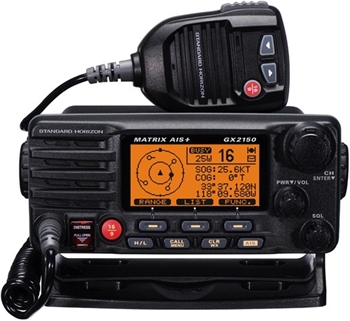
So, the Admiral got me a Standard Horizon 2150gx with AIS over the winter and added a RAM Mic to the pot as well.

The with "AIS" is the over the top addition. Intrepid readers can google AIS - it's a automated id system, that, like DSC  when it has a GPS feed works like radar - it plots the sending unit on a radar like screen and tells me who they are, where they are, and where they are going. It only works for 'ships' - freighters and such that are required to broadcast AIS signals.

The SH 2150gx is the ONLY VHF radio that does this - I'm amazed no other product has this feature STILL. At 327 bucks it's price is in line with other high end VHF radios that don't have AIS.

A AIS receiver as a standalone is 500 bucks. Icom and Raymarine are missing the boat on this one.

It is a tad bit larger than the Ray 54 - but it does accept a signal from my GPS - as well as output a signal to my laptop, a PA system with a programmable fog horn and other neat features.
Running the wires was a snap - just a couple hours of pulling and pushing and such to get it done. Installing the RAM mic was bit tougher as the end of the cable is a one inch connector that required  a lot more room to lead. All said and done, three hours of work and it's up and part of the boat.

Thursday, November 17, 2011

Cruising vs Racing

I'm a Cruiser / Racer as opposed to a Racer / Cruiser. Both have there place in sailing.


I was asked by a good friend and sailing buddy why I'm spending boat bucks on performance gear (sail tweakers like travelers and vangs and such) considering I don't race Patience Two .


I don't race her because I can't - a) she's a catamaran and there isn't a good catamaran racing venue close by. Mono hull owners don't like racing with multi hulls because we can and do exceed hull speed (as a reminder hull speed is the fastest sustained speed a displacement sailboat can go based on the formula
1.34 times the square root of the length of the hull at the water - for my boat that's about 7.55 - my LWL is 31.75 feet).  If you  don't believe that witness the last America's Cup - done in multi's pulling 20kts of boat speed in 6kts of wind. 
I've topped 10.3 kts on my boat. In the right wind (over 16kts) a mono has no chance. 


and b)  I can't - she's not set up for it (missing sail tweakers like travelers and vangs and such - and carrying all the cruising gear Mary and I prefer not to unload and load all the dang time. 


I race on friends boats - like my friend Mikes Hunter 216, a light weight sport boat that will kick ass on the water. The last season I raced we pulled a 1st for the series I participated in, beating bigger "faster" boats head to head and kicking them around on corrected time.


Okay, next post on cunninghams and outhauls and more heavy metal stuff.

Tuesday, November 15, 2011

Winter Upgrades - Heavy metal

With the boat all naked what with no sails and all I've had a chance to look her over and consider what I'm going to do with her this winter.

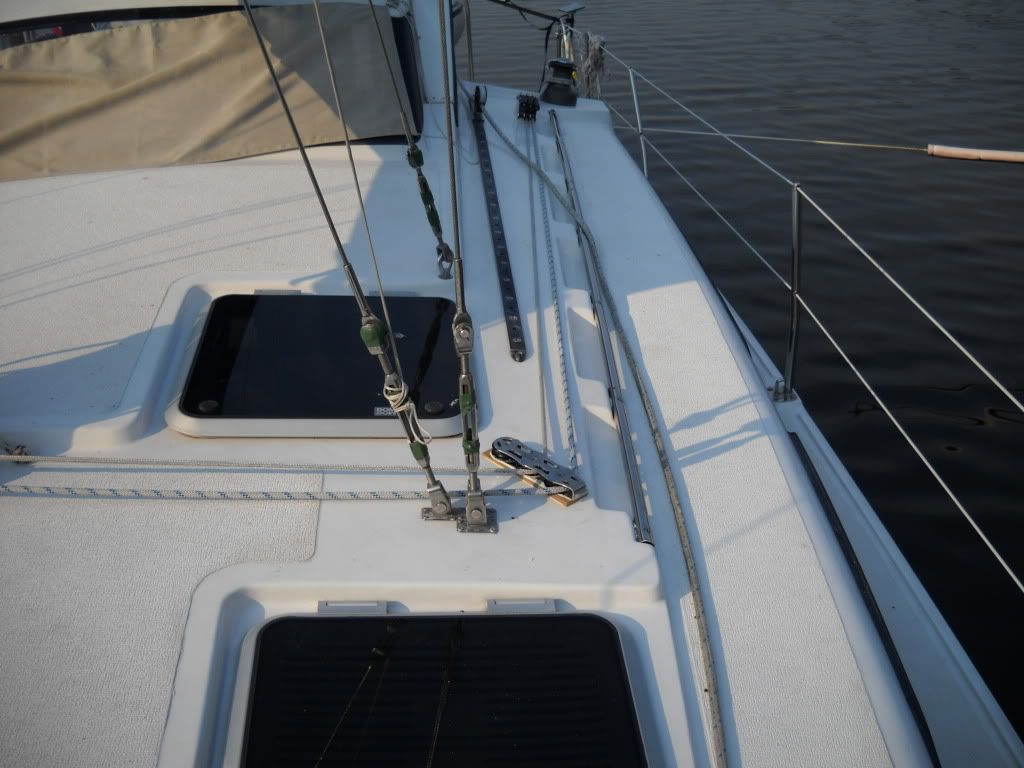
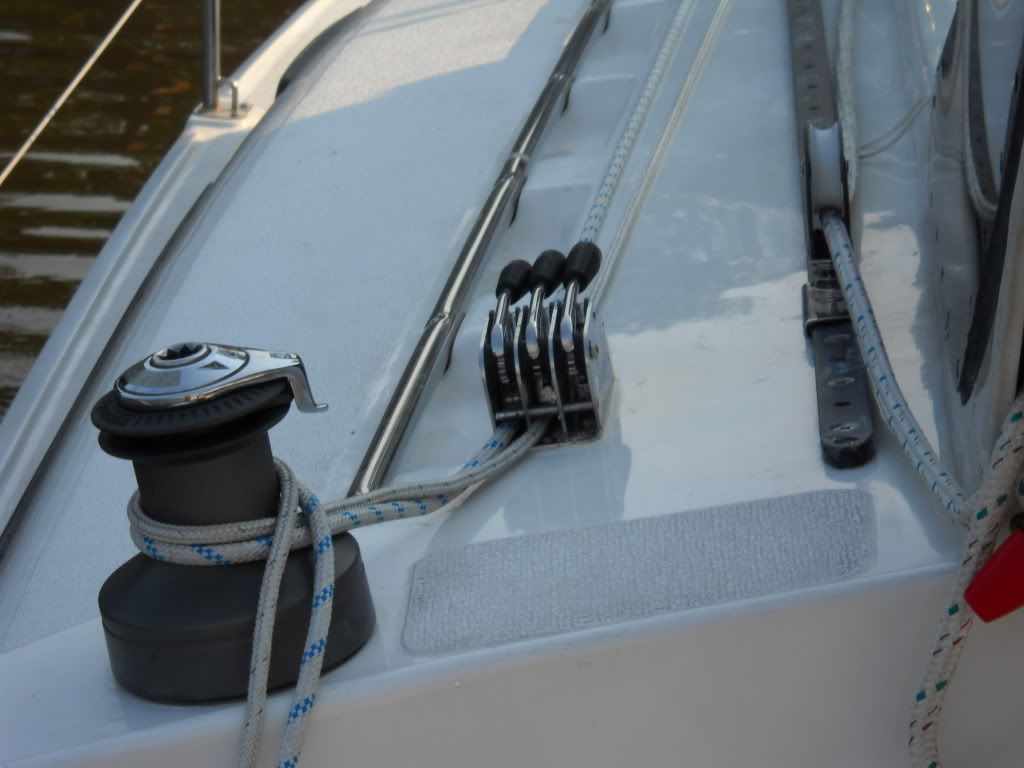
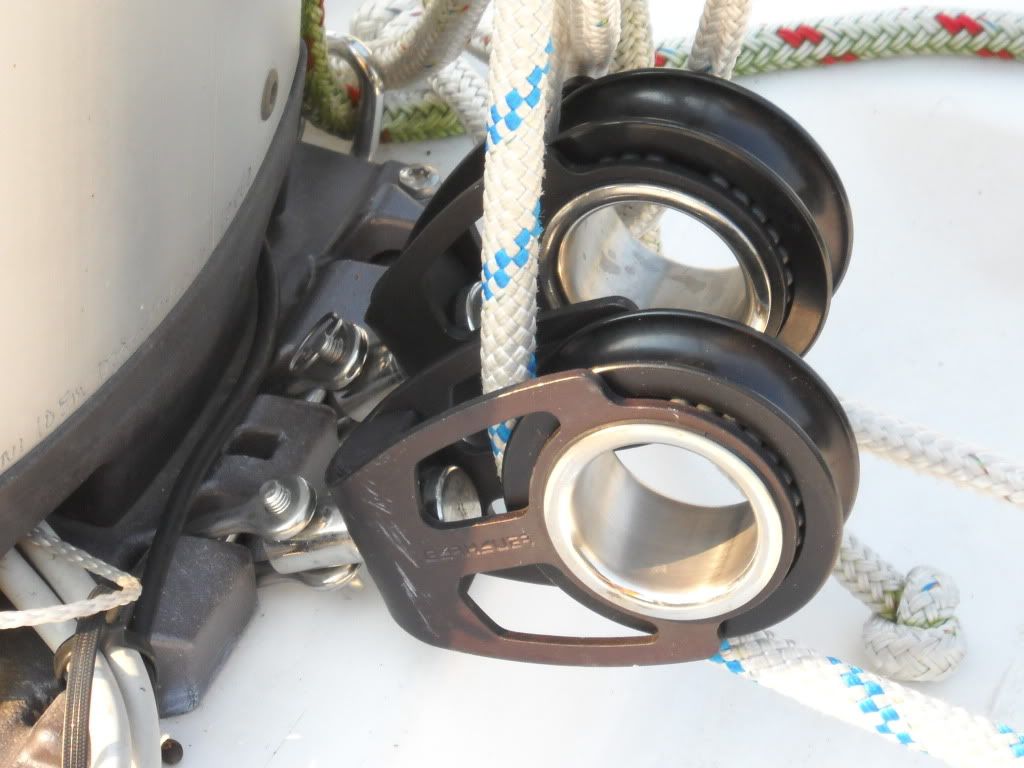
Right now I've got 2 deck organizers on the port side that allow me to run 6 lines back to the cockpit. Really they can handle 4 lines because the end two sheeves (turning blocks) lost their ball bearings when I installed them.
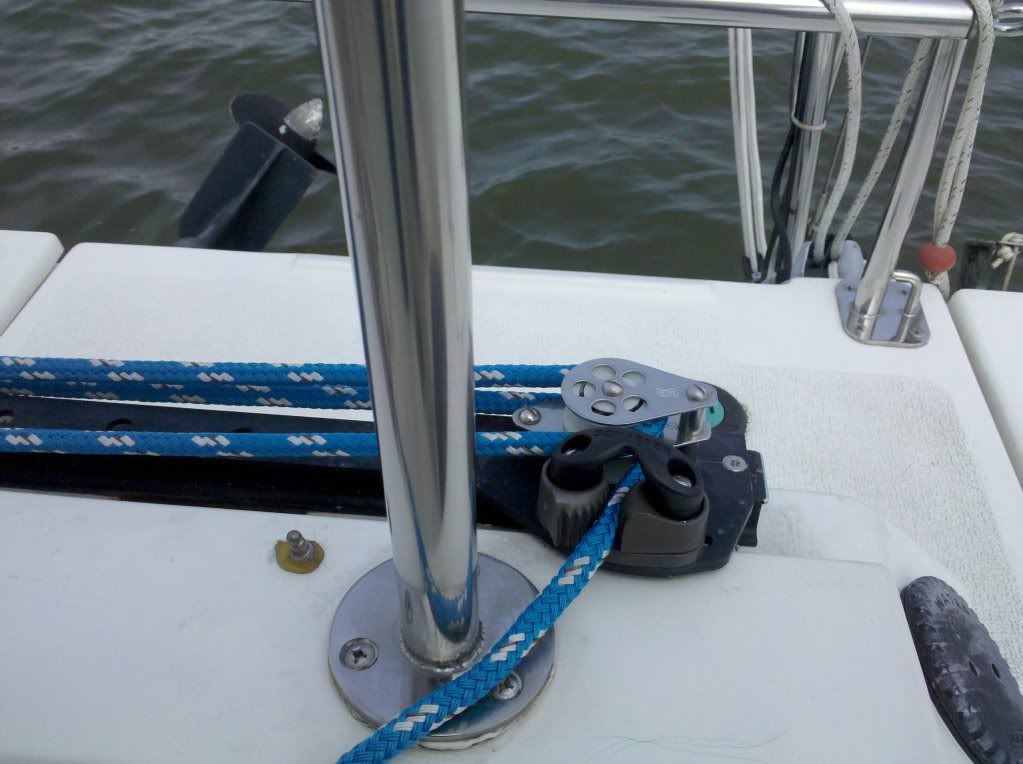
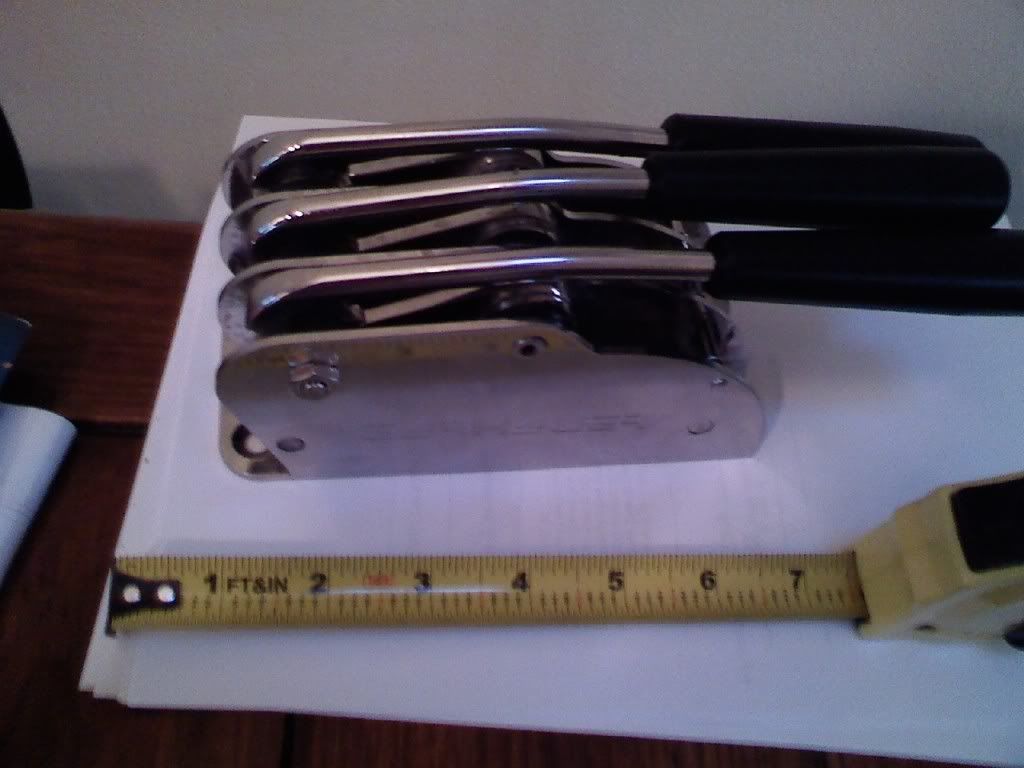
Currently I run the main halyard, boom vang and outhaul through them and to a clutch, the clutch is pictured in a previous post - it is the 3 line version of this.

Last week I ordered a new 3 line clutch, same as I have on my port side. I'm going to install it on the starboard side.
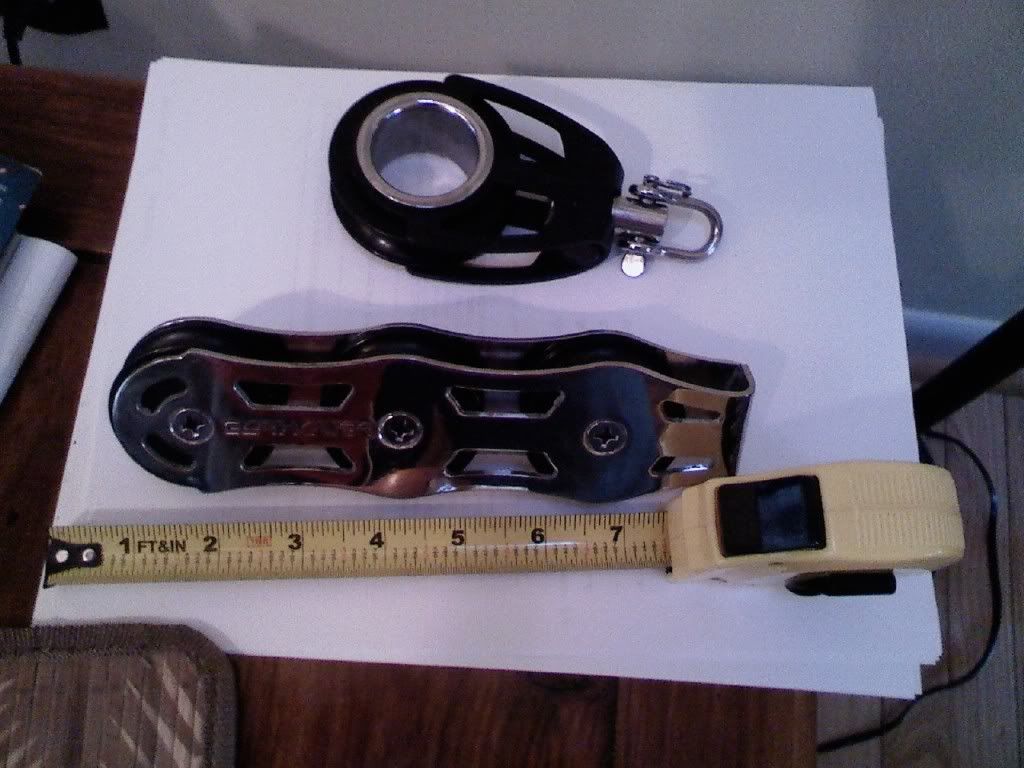
I also picked up a set of genoa track car's  like the ones pictured to the right. Call me silly by I like Garhauer's stainless steel line, it's heavy, but it's tough. These cars allow you to pull the genoa car forward so you can adjust the sail's clew without leaving the cockpit. Without cars you have to pull a spring loaded pin to disengage the car, then shove it against the pressure of the wind.
Note the car has a fiddle (flat) double block and a double stacked block with a end termination separate. The double stack/end terminal unit goes all the way forward on the track and gets secured there (the screw on the end). The control line leads from the terminal end to the big block on the fiddle, back to the double on the bottom, then back to the small block on the fiddle, back to the terminal block on top, then back to one of these at the rear of the track, and within reach in the cockpit:

 To move the car you simply pull the line which allows the car to slide forward (it's riding on ball bearings). The 5:1 blocks (the way the lines run fore and back around the blocks (land lubbers call them pulley's) mean that it takes 1/5 the effort minus friction loss to move the car. That's good because sometimes the wind puts so much pressure on the sails you can not do it without help.
The car will slide to the stern under wind power (the genoa is pulling it up and forward all the time, the control line is holding it still).

You adjust these cars to allow the clew (back, bottom) of the genoa (forward sail) to move forward / aft and in and out.
Let's see if I can describe it for both sailors and non-sailors. When sailing upwind (into the wind) you want the genoa  to be back and tight to the center line of the boat, that allows it to point into the wind and causes the wind to channel better over the back of the main sail. That channeling creates what a sailor calls the "slot".
To effect that one would put the car further aft, and where it goes and works best depends on wind speed and whether or not you have the genoa reefed (made smaller because of high winds). My first 'reef point' is to furl my 150% genoa to 100%.

- a brief side note, 100% refers to the area of the fore triangle; a triagngle that is sided by the deck (foot of the sail), the mast and the luff (forward edge) of the sail. A 150% genoa, like mine infers that the clew of the sail goes back another 50% past the mast. My foot is 14 feet (tack of the jib to the mast) so a 150% would be 7 feet longer, I have a furling genoa, it rolls around the forward edge (on a aluminum foil) to store it, and to make it smaller in high wind...end note

What that means is that in order to have the clew (back, bottom) of the genoa held at the same angle relative to the wind when I furl the sail to the first reef I need to move the car 7 feet forward of where it was at 150%. That's a lot of push pin pulling and car sliding while standing bent over a track in 20 knots of wind. Hence I'm adding the cars. It's not just performance, it's safety.

Ah, but there is more.
When going downwind and even on a reach (side ways to the wind) you want the clew of the genoa to be able to curve out ward away from the center line of the boat. Consider that the main sail is going to also go away from center line when sailing at 90 degrees off the wind, would you want your genoa to curve inward and have the wind from it back winding the main sail? So you move the car forward to prevent that cupping force.
Downwind you want that big honking sail out so it can catch air like a kite, you move the car all the way forward so you aren't closing the sail up like a laundry bag.

Still more, because gosh if there wasn't anyone could do it (well actually anyone can do it)...
There are times when you want to pull the car more forward than normal. Pulling the car forward when going upwind puts more 'bag' in the sail, making it rounder and fuller. A rounder sail means you can't point into the wind as well, but gives more "power" i.e. pulling force, something you need in heavy chop/waves, or in truly light and fluky wind - it's better to move a 50 degrees than to not move at 40 degrees off the wind.

Next up, we'll talk Cunningham's, Out hauls and what all that other heavy metal is for.

Monday, November 7, 2011

Empty inside

My boat is naked, inside and out.
Mary and I stripped the sails off and pulled all the stuff that makes it a home on the water off this weekend. Late fall is upon us and winter is approaching, a good time for sailing as the wind is generally a little bit better; a bad time for sailing as there is a reason they call the fall regatta's 'frostbite regatta's'.

My 1955 Lyman 15 foot  runabout is hanging from straps in the garage (literally, 2 2inch wide straps with sawhorses to stabilize).

So what does a sailor do when he's reduced to be a motor boater? Apparently he gets out the leaf blower.

Some would think it's the lazy season - ha, ha, ha. Not. Now's when the work begins. Those sails that provide us effortless and fuel less power to sail around the world require routine maintenance unless you want to replace them to the tune of 2 grand or more (EACH)  every couple of years.
That means either you fold them up (take out battens, batten cars, ropes and such) and ship them off to be cleaned and inspected - Now that's a 200 bucks or more to box and ship. We have b i g sails.
Or ROAD TRIP !
We are going to pack them up and take a road trip next weekend to deliver them to Sail Care, they rebox and ship back as part of the price.


Oh, and stay tuned to for the mad adventures in bottom stripping. It sounds sexier than than it really is.

In this case I get to lay on a cold concrete floor with 600 pounds of wooden boat over me while I sand, chip and scrape paint off the Lyman, meanwhile it rains lead based paint on my face. In a garage with no heat.


Better be some good times next year.

Wednesday, November 2, 2011

Music

My iTouch died 2 months ago.

I don't have many songs on it, but they were important to me. I have a VERY eclectic taste for music - I like everything from Lady Gaga to Lady Antebellum and throw a little Beethoven's 9th in on the side.While I can indeed dance  - my singing is akin to a bull frog on helium but I try it anyway. Funny story there... let me digress...

My friend and new dockmate (it's his Coronado 25 I talk about) - Marc was singing along to his newly installed radio a week or so ago while I was on my boat abusing my windex (calibrating it). Across the 30 - 40 feet separating us I asked him loudly:
"what did you do with the money?"
His instant response?
"drugs"

How many of you would have inferred the rest of the question with no reference - "that your mother gave you for singing lessons"...?

Music is important to some folks.
Some folks just get it.

Marc installed his stereo after ensuring his deck was not  leaking anymore. I installed my  speakers in the cockpit as the first hole I cut in the boat.

My wife fixed my iTouch tonight, she went to the Apple store and braved the lines, the arrogant customer service and  rest. I have a new iTouch at 1/4 the price of the old one. ALL of my songs are back on it.

I have music again.

Enrique Iglesias "Hero".

enough said.

Christmas wish lists

I've been easy over the past eight or nine years - Santa can bring me boat stuff and it works.

Random time is over, I have needs :)

Here's the problem boys and girls, I like power, I use power, I have to replace power.
Gee, you ask - how much power do you need - you are already the skipper of your boat, the captain, master of your destiny.
Well - the answer gets complicated. Farting around on your boat can take many different forms and the consumption and manufacture of electricity can as well.

Woe to the dude who gets up in the morning and cranks a key to clicking sounds from the engine compartment.

My daily draw can exceed 70 amp hours (a amp hour is using 1 amp for 1 hour - a typical light on a boat draws 1 amp per hour).
Some boaters basically wing it. Some get all anal retentive about it. I'm somewhere in the middle, for instance I don't turn down the stereo speakers to save power (those are after all 100 watt speakers) but the meter does trickle away in my mind....
Here's my usage, broken down by category.
CPAP (apnea) - 1.2 amp -  7 hours      =  9ah
Stereo (must have) 1.4amp - 10 hours = 14ah
Anchor light 1.1 amp - 9 hours   = 10ah
Lights - 1amp each - 6     = 6ah
Fans (3) .5 - .7amp        = 5ah
Standard  -                      =  16ah
Additional/random        = 10ah

Standard is a fill in for CO2 detector, propane shut off valve (fails shut on loss of juice), fridge fan, battery monitor etc.. all that stuff you can't shut off.
Additional is all those other things - water pump, phone charging, turning on my wind instuments just to check, GPS for anchor alarm or chartting my next day..just 'stuff'. It can go higher (laptop charge) but seldom goes lower.

My current 'system' - because it has to be viewed as a system not a list of components - is:
Cranky - what I call my Westerbeke 30B diesel. It has a standard 55 amp alternator.
80W Kyocera solar panel - makes 30-40 amp hours a day on a good day.
Xantrex C12 controller  3 stage charger - max amp out is 12, normal is 3 to 4.
Xantrex XBM monitor - to watch all this magic happening.

I have battery chargers and combiners and such; we'll skip them because this is about hook time, not pier side. The combiner is a safety feature - puts the banks together or detaches them on low voltage to prevent that nasty silence thing when I turn the key.

So that leads me to this - begging


A 240w solar panel.
A 20 amp controller for the above (ask me for the brand).
A pair of Trojan batteries to hold the output (ditto, ask me for size and type).

Get in line folks, I expect the offers to come pouring in any day.

Tuesday, October 25, 2011

Yak Yak Yak - less talk, more sailing

Someone mentioned they would like to see a conversation on sail trim etc. on the Gemini, here’s my effort to start it.

For reference I have eliminated the backstay and replaced it with a boomkicker and installed a 5:1 soft vang and the vast majority of my lines are led aft.
I'm going to front load the pictures..enjoy:
My traveler has the modification for control lines vs. pin stop


Block to lead sheet from mast and turning block to lead aft. 


 Mounted, port side (still in progress when this taken)
 Garhauer 3x stainless clutch


 Mounted


 Blocks to take (in this case) the topping lift and the main halyard (blue checked) to the turning block - and from there to the clutch


 Okay - that's your visual fix - now to the yak yak yak part...


Back stay use on the Gemini –

From the manual:

* The back stay should be tightened to the point
where all slack is eliminated but with no bow or
bend in the mast. The check stays are present only
to eliminate mast pumping and are tightened to the
point where there is just a small amount of slack.
The baby stay should be tight enough to put a small
pre-bend in the mast so that when the Genoa pulls
forward in heavy wind, the mast straightens up.

As a side note in 2009 we had a massive snow storm (Annapolis Md area) that contributed to sinking a Gemini at the pier because the backstay chain plates had ¼ cracks – my conjecture is that the tension was left on too much, too long.
The weight of the snow submerged the top step, once water got in it was just a matter of time.  Like the manual says, release the tension on the backstay while not sailing (and for downwind work). It should have no slack, but not be tight while at the pier or motoring. I’ve spoken of this in other posts, it’s searchable.
If you follow boating news there was a Tartan 4000 that was essentially totaled by what Tartan ascertained was ‘excessive backstay tension’ – it cracked the stern and amidships. Your mileage may vary, but my opinion is to use it sparingly.
Selden and PCI designed the mast to be mostly straight and need minimal adjustment. That’s per a conversation I had with Tony in 2008.

Putting tension on the backstay pulls the mast top back which has the effect of pulling the genoa or screacher luff tighter. It works in combination with the baby stay forward to put a slight (very slight) curve/bend in the mast. That bend works just like a beer belly on a tee shirt – it pushes the belly of the main sail forward and tightens it up in the middle section while at the same time the top bending back (even an imperceptible amount from the deck) has done its work on the genoa or screacher.  For me sparingly translates to pulling the slider down about 2 feet for maximum tension. I might not get as much as I could, but I’ve not broken anything.
For windward work this improves pointing and sail shape of the fore sail. The luff of the foresail is where the ‘speed’ comes from, so the better it’s shape the better the airflow through the mid section because the air doesn’t separate from the sail curve prematurely.
This is turn creates a better slot between the genoa and the main. The slot accelerates the air that flows over the leeward side of the main – increasing its efficiency.

For reaching – less tension is needed but truly the best gauge is the gauge (speed log or GPS) – play with the backstay tension and see where the best performance is. One of the best things I’ve done is go out single handed so I KNOW where everything is set or changed and I can see the changes good or bad on both balance and speed.

An often overlooked control device are the jib leads, the Cunningham and  the outhaul. Dave Berig put a Cunningham in the main but most owners I’ve seen don’t have it rigged for use. The outhaul is left at the mast (the center ‘gold and white’ on my boat) and underused as well. Mine was so short I’d have had to lay on the deck under the mast to do anything with it. Instead I lengthened mine using a sheepsbend knot, put a block at the mast base and lead it back aft – right now on the port side but this off season I’m reorganizing the lines so that the port side will have the main halyard, first reef (clew) and first reef (tack) led to a 3 slot clutch (it’s main halyard, outhaul and vang now). I’m putting the outhaul, vang and Cunningham on the starboard side so all the main sail controls are at the helm.
All of these controls work the same on the Gemini as they do on Half-boats (mono hulls).

I just this season mounted  the boomkicker and vang so I’ve got minimal use – but the vang is VERY handy for downwind sailing – it stops the boom from lifting and helps (with a preventer) to keep the boom from bouncing all over in the chop we get here on the Chesapeake. My vang is loosely mounted (1 screw to the boom) – with the intent I’d rather it pop off than my boom break.  Obviously I’m still experimenting with it.
I run a preventer from the back of the boom (snap shackle) to the a block that is attached to my anchor cleat and then back aft to the winch. I get full adjustability out of it that way. If I’m wing on wing I move it to the jam cleat so I can use the winch for the genoa/screacher sheet.

Cunningham’s are the cringle on the luff of the main about 4 feet up from the boom. You can crank away at the main halyard and put it mostly right – but a simple line with a figure 8 stopper tied through the Cunningham lets a 120 pound weakling pull out more slack from the mid-bottom section with minimal effort. It’s useful to both create or eliminate more curve in the luff of the main (create for downwind, eliminate upwind.
Ditto on the outhaul – pull tight for upwind and or heavy air – slack off for more power in choppy water or ‘bag’ going downwind. I’ve not noticed a significant difference (yet) – but on my buddies 216 Hunter it makes a wow difference.

Leading both the reef clew (back of the main) and the tack (cringle on the sail with a stopper knot and rope led aft) in the cockpit makes it as close to a single line reefing system from the cockpit as we can get without replacing the boom. Putting in on the same clutch as the main halyard makes it a simple job, e.g. lower the main to a pre-marked spot on the halyard, pull the reef clew line (blue on mine) until the clew is all the way down, pull the in rope attached to the reef tack until tight, readjust halyard for final. Since I’m a weekender/daysailer at the moment I don’t envision a need to lead the second reef aft (that’s the polite way of saying I have a motor for when the wind gets that high).  

Jib leads should be set based on the amount of genoa you are using – I’ve found that about I foot behind the window (almost all the way back) is good for upwind, full genoa. Downwind work seems to improve by sliding them forward about 6 feet – it helps the clew of the genoa get out there in good air. Somewhere about half way (mid boat) works good on reaches because there you need to open the slot a little and get the wind flowing on the back of the main.  Real racers mark the deck or track with where they want the cars.
A simple relatively inexpensive upgrade is to put make your jib lead cars ‘towable’ – put a block and termination (shackle) at the bow end of the track and another block on the car – lead a control line from the shackle through the block on the car back to the block at the end and then back to a clutch/cam cleat at the helm. The pressure of the genoa will (on release) move the car back towards the stern – and you have a 3:1 purchase to pull the car forward. Kits sold in pairs to do this run about 250-300 bucks.

By the way, I’m using Garhauer 40mm swivel blocks for all this – 25 bucks at a boat show. I picked up 6, the shackle goes right through the pin at the base of the mast simply. My turning blocks are 40mm sheeves-  stackable 3 space Garhauer’s – make sure you get the models with captive bearings or they will scatter everywhere J. You’ll need to bevel a plate / teak piece to level the turning block. Mine are mounted just off  the hatch and angled to lead all lines ‘just’ inside the winches.
Garhauer is heavier generally, but stronger. I also use their stainless steel 3x clutches. Drilling and mounting is simple. Keep in mind that the forces are primarily sheer (side load) not lifting – except at the block.

I don’t generally put a lot of pictures here but do have them on Anything-Sailing.com and on my blog.